Why CO2 is growing, and why it is different
Carbon dioxide (R-744) has a global warming potential of 1, is non-flammable, non-toxic at normal concentrations, cheap and widely available. As HFC phase-down pressure grows, CO2 is increasingly used in supermarket racks, cold stores and industrial cascade systems, often with ammonia or an HFC/HFO on the high stage.
Thermodynamically, CO2 is unlike any refrigerant most technicians grew up with:
| Property | R-744 (CO2) | Why it matters for the oil |
|---|---|---|
| Critical point | 31.0°C at 73.8 bar | Above this, heat is rejected in a gas cooler, not a condenser, at pressures that can exceed 100 bar |
| Triple point | -56.6°C at 5.2 bar | Below this, CO2 forms dry ice; systems must stay above it |
| Evaporating pressure at -30°C | about 14 bar | Several times higher than an HFC at the same temperature, so oil reservoirs sit at high pressure |
| Solubility in POE | Very high | Large amounts of CO2 dissolve in the oil, strongly reducing working viscosity |
Subcritical and transcritical duty
Subcritical systems keep CO2 below its critical point throughout the cycle. The classic example is a cascade in which CO2 serves the low-temperature stage and rejects heat to an ammonia, HFC or HFO high stage. Pressures are high by HFC standards but well defined.
Transcritical systems, such as booster racks, reject heat above the critical point whenever the gas cooler cannot get the CO2 below about 31°C. Because a gas cooler always runs a few degrees above ambient, that happens once ambient temperatures reach the mid-twenties. In most Southern African climates a CO2 booster will therefore run transcritical for a large part of the year. Discharge pressures and temperatures are higher, and compressor and oil selection must follow the compressor manufacturer's approved list exactly.
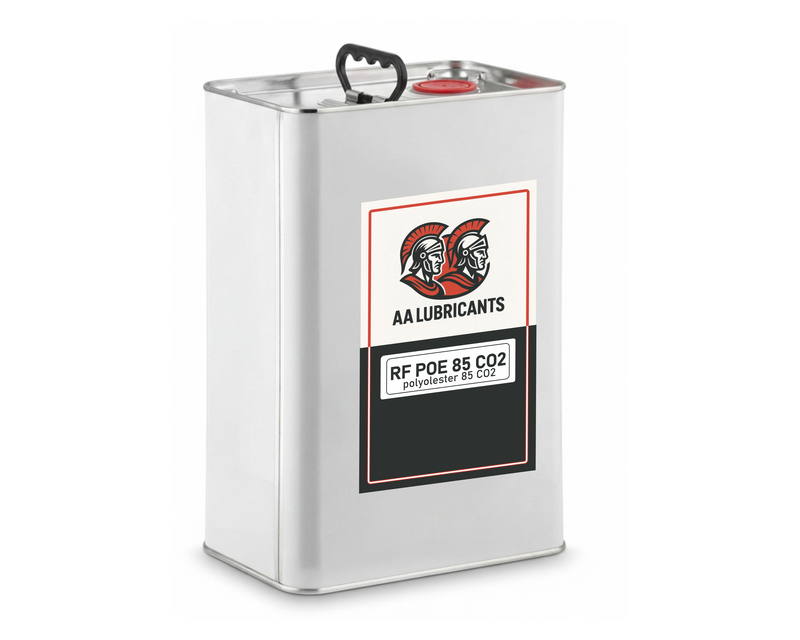
Our RF POE 85 CO2 is specified on its technical data sheet for subcritical R-744 applications as well as HFC systems. For transcritical compressors we work from the OEM's approval list and will tell you plainly when a different product is required.
What CO2 demands from the lubricant
1. Viscosity reserve against extreme dilution
Because CO2 dissolves so readily in POE, the working viscosity at the bearings falls far more than the ISO grade suggests. CO2 compressor oils are therefore formulated at a higher base viscosity than an HFC oil for an equivalent machine. RF POE 85 CO2 has a typical viscosity of 86.3 mm²/s at 40°C to provide that reserve.
2. Miscibility at very low temperatures
CO2 low-temperature stages routinely evaporate at -30°C to -50°C. The oil must stay in a single phase with the refrigerant down to those temperatures so it returns from the evaporator. RF POE 85 CO2 shows a typical two-phase separation temperature of -60°C at 20% oil in 80% R-744, a floc point of -55°C and a pour point of -36°C.
3. Anti-wear performance at high load
High pressure differentials put high loads on bearings and running gear. The additive package must maintain a protective film when the diluted oil film is thin.
4. Chemical stability and moisture control
Water in a CO2 system forms carbonic acid in addition to the usual POE hydrolysis risk, and free water can form ice or hydrates at low temperatures. CO2 systems generally need to be kept drier than HFC systems. Evacuation standards, drier sizing and oil handling are critical (see our article on moisture and acid control in POE systems).
RF POE 85 CO2 at a glance
| Property | Test method | Typical value |
|---|---|---|
| Kinematic viscosity @ 40°C | GB/T 265 | 86.3 mm²/s |
| Flash point (open) | GB/T 3536 | 245°C |
| Pour point | GB/T 3535 | -36°C |
| Acid value | GB/T 4945 | 0.05 mg KOH/g |
| Moisture content | SH/T 0207 | 80 ppm |
| Floc point | GB/T 12577 | -55°C |
| Two-phase separation (20% oil + 80% R-744) | SH/T 0699 | -60°C |
Complies with GB 16630-2012. Typical values are for reference; specific values may vary with test conditions or OEM requirements.
Commissioning and service checklist for CO2 plant
- Confirm the compressor OEM's approved oil and viscosity for the exact duty (subcritical or transcritical).
- Charge oil from sealed containers with a closed pump. Never top up from a previously opened POE drum.
- Evacuate deeply and verify with a decay test before charging CO2.
- Monitor oil level and oil temperature closely during the first weeks; CO2 systems often redistribute oil as they settle.
- Sample the oil for water, acid number and wear metals at commissioning and at regular intervals thereafter.
Designing or servicing a CO2 installation? Our technical team can review your compressor, cycle and operating envelope and recommend a lubrication approach. Contact us at sales@aalubricants.co.za.

